


French Bulldog Joint Health: The Complete Frenchie Owner’s Guide
Why up to 30% of French Bulldogs develop hip dysplasia — and what their compact build means for joint support starting early
French Bulldogs are at high risk for joint problems due to their chondrodystrophic build — the same genetic trait responsible for their short legs, compact body, and heavy chest. Studies suggest up to 30% of Frenchies show some degree of hip dysplasia on X-rays, and they also face elevated risk of patellar luxation and intervertebral disc disease (IVDD). The best joint supplements for French Bulldogs combine glucosamine, chondroitin, MSM, hyaluronic acid, and turmeric — ideally starting before visible symptoms appear.
French Bulldogs are the most popular companion breed in America — and with that popularity comes a responsibility most new Frenchie owners don’t get until something goes wrong. Their adorable, compact build is also the source of very real joint vulnerabilities that are built into the breed’s genetics. This guide breaks down exactly what those risks are, what the science says, and how to protect your Frenchie’s joints for the long haul.
French Bulldogs are among the breeds most studied for orthopedic conditions, with peer-reviewed veterinary research confirming glucosamine and chondroitin as the most evidence-backed first-line joint support supplements for dogs with these structural risk factors.
French Bulldog Joint Risk — By the Numbers
These figures come from orthopedic studies and veterinary insurance data on the breed:
The 3 Joint Conditions Every Frenchie Owner Should Know
French Bulldogs face a specific combination of joint challenges driven by their chondrodystrophic genetics — the same trait that gives them their signature look also creates structural joint vulnerabilities.
Why the Frenchie Build Creates Joint Risk
Understanding why French Bulldogs are at risk makes the importance of early supplementation much clearer.
French Bulldogs carry a genetic trait called chondrodystrophy — the same gene family that gives Dachshunds, Corgis, and the Shih Tzu their short legs. In Frenchies, this trait creates a compact, heavy-chested body on a disproportionately short frame. The result is that their joints — particularly the hips — carry a heavier load relative to their size than most breeds of equivalent weight.
Additionally, their rounded, compact pelvis creates a shallower hip socket than ideal, which is a primary driver of their high hip dysplasia rates. This isn’t a health problem that develops from poor care — it’s built into their anatomy from birth. Which is exactly why proactive joint support matters more for Frenchies than for most companion breeds.
French Bulldogs are remarkably stoic and adaptable. Their muscular, compact frame allows them to compensate for joint instability far longer than other breeds — which means by the time you notice something is wrong, the underlying joint changes are often well established. This is why starting joint support before symptoms appear is the single most important action Frenchie owners can take.
This is exactly what early joint struggle looks like in a French Bulldog — and what happens after support begins. Watch this real before-and-after transformation. The difference at the end will surprise you.

Signs Your Frenchie’s Joints Need Support
Because French Bulldogs compensate so well, the early signs are often subtle. These are the Frenchie-specific indicators to watch for:
- Bunny hopping — both back legs moving together rather than alternately, the most recognizable early hip dysplasia sign in Frenchies
- Intermittent skipping or leg-holding — picking up a back or front leg mid-stride, classic sign of patellar luxation
- “Speedo” posture — skinny hips with puffed shoulders as your Frenchie shifts weight forward to compensate for hip joint instability
- Reluctance to jump onto furniture or into the car — Frenchies normally love to be elevated; hesitation here is meaningful
- Stiffness after rest — slow to get moving after napping, takes longer than usual to reach their normal gait
- Reduced zoomies and play activity — Frenchies are naturally playful; a significant drop in spontaneous activity is worth investigating
- Crying or flinching when back or hips are touched — sensitivity in the lower back or hip area warrants a veterinary evaluation

When to Start Joint Support — A Frenchie Age Guide
Because French Bulldogs compensate so effectively early on, starting joint support before symptoms emerge is especially important for this breed:
The most important things at this stage are maintaining a lean weight and using ramps instead of letting your Frenchie jump on and off furniture. Have your vet assess hip and knee joints at annual checkups. Very active Frenchies or those from lines with known dysplasia history can start supplements earlier.
This is the most impactful window for Frenchie joint health. Underlying joint changes are progressing below the surface while your dog still appears completely normal. Starting glucosamine, chondroitin, and MSM at age 4 consistently produces better long-term mobility outcomes than waiting for visible symptoms. Don’t wait for the limp or the skip.
Senior French Bulldogs show more visible joint changes. Daily supplementation at this stage supports cartilage integrity, joint lubrication, and a healthy inflammatory response. Combined with orthopedic bedding, ramps, and regular low-impact walks, most senior Frenchies maintain surprisingly good mobility with consistent support.
What to Look for in a French Bulldog Joint Supplement
French Bulldogs need a formula that addresses all three of their joint vulnerabilities simultaneously. Here’s what each ingredient does and why it matters specifically for Frenchies:
🦴 AdvancedPUP’s 7-in-1 Formula — Designed for Frenchie-Level Joint Challenges
All 6 Frenchie-critical ingredients in one bacon-flavored daily chew. Glucosamine + Chondroitin + MSM + Hyaluronic Acid + Turmeric + Hemp Oil. 60-Day Empty Bottle Guarantee.
🛒 Shop AdvancedPUP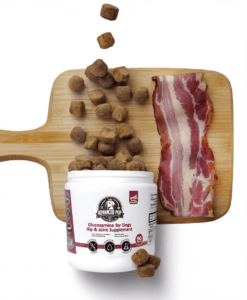
Weight Management — The Single Biggest Variable for Frenchie Joints
Every veterinary source on French Bulldog joint health lists weight management as the most impactful modifiable factor — and for good reason. Excess body weight is the single biggest driver of how quickly joint changes progress in Frenchies.
French Bulldogs have a compact, heavy-chested build that already puts above-average load on their hip and knee joints. Even 2–3 extra pounds amplifies that load significantly due to the physics of their frame. A Frenchie at their ideal weight and a Frenchie 3 pounds overweight experience very different levels of daily joint stress — even doing exactly the same activities.
The combination of lean body weight maintenance and daily joint supplementation starting at age 4 is the most evidence-supported approach to long-term Frenchie joint health. Neither alone is as effective as both together.
Exercise Dos and Don’ts for French Bulldogs With Joint Concerns
✅ What Helps
- Short, frequent walks on soft surfaces — grass and dirt absorb impact far better than concrete or pavement for Frenchie joints
- Ramps for all furniture and car access — eliminates the repeated joint impact of jumping, the most important environmental modification for Frenchie joint health
- Orthopedic memory foam bedding — supports joint alignment during the extended rest periods Frenchies love
- Harness instead of collar — eliminates neck and spinal stress from pulling, particularly important for chondrodystrophic breeds
❌ What to Avoid
- Repetitive jumping — on/off sofas, in/out of cars without a ramp — each landing impact loads Frenchie hip and knee joints significantly
- High-impact play like frisbee or rough wrestling — twisting and high-speed direction changes place acute stress on unstable hip and knee joints
- Slippery floors — Frenchies splay their legs on hard floors, creating abnormal hip joint loading that worsens existing instability
- Overheating during exercise — Frenchies’ brachycephalic airways make them overheat faster, causing them to push joints harder than they should to keep up
Sadie limps less with this supplement and she treats it like its a treat which is helpful.
What a French Bulldog Actually Needs Per Day — Serving and Cost
Most adult French Bulldogs weigh between 16 and 28 lb, which puts almost every Frenchie in the same serving band. Serving is set by body weight, not by breed, so weigh your dog rather than estimating — a Frenchie carrying a few extra pounds can cross into the next band.
| Dog weight | Chews per day | One 90-count bottle lasts |
|---|---|---|
| Up to 10 lbs | 2 chews | About 45 days |
| 11 – 30 lbs ← typical adult Frenchie | 3 chews | About 30 days |
| 31 – 60 lbs | 4 chews | About 22 days |
| 61+ lbs | 5 chews | About 18 days |
A typical adult French Bulldog lands in the 11–30 lb band: 3 chews a day, and one 90-count bottle covers a full month with no partial-bottle math. At the current bottle price of $34.98 that works out to roughly $1.17 a day before any coupon. A Frenchie puppy or a very small adult under 10 lb takes 2 chews, and a bottle stretches to about six weeks.
What 3 chews a day delivers
The label states amounts per serving, and a serving is 2 chews — a 90-count bottle is 45 servings. Glucosamine, chondroitin and MSM appear on the label as a single 550 mg proprietary blend, which is what those three add up to per serving.
| Ingredient | Per chew | Per serving (2 chews) | Daily at 3 chews |
|---|---|---|---|
| Glucosamine | 150 mg | 300 mg | 450 mg |
| Chondroitin | 100 mg | 200 mg | 300 mg |
| MSM | 25 mg | 50 mg | 75 mg |
| Turmeric | 35 mg | 70 mg | 105 mg |
| Hemp Seed Meal | 25 mg | 50 mg | 75 mg |
| Cold Pressed Virgin Hemp Oil | 25 mg | 50 mg | 75 mg |
| Hyaluronic Acid | 1 mg | 2 mg | 3 mg |
How many joint chews should a French Bulldog have per day?
Most adult French Bulldogs weigh 16 to 28 lb and fall in the 11–30 lb band, which is 3 chews per day. A puppy or a very small adult under 10 lb takes 2. Serving is based on body weight rather than breed, so weigh your dog rather than estimating, and check with your veterinarian before adding a supplement — particularly if your Frenchie is already on medication.
How much does it cost to keep a French Bulldog on a joint supplement?
At 3 chews a day, a 90-count bottle lasts about a month. At the current $34.98 bottle price that is roughly $1.17 a day before any coupon — one of the lower monthly costs among breeds, simply because a Frenchie’s size keeps the serving small.
Frequently Asked Questions
Related Guides for French Bulldog Owners
Your Frenchie Deserves Breed-Specific Joint Support
AdvancedPUP’s 7-in-1 formula addresses all three of the French Bulldog’s unique joint challenges — hip, knee, and spine — in one daily bacon chew they’ll actually look forward to.
🛒 Shop AdvancedPUP — Risk-Free Trial 🛡 60-Day Guarantee | 🚚 Free Shipping | 🇺🇸 Made in USA