

Saint Bernard Hip & Joint Problems: Why They’re So Vulnerable — And How to Give Them More Good Years
Saint Bernards have one of the highest joint disease rates of any breed. But slowing down doesn’t have to mean the end. Here’s what the data shows — and what you can do starting today.
Saint Bernard hip and joint problems are among the most serious of any breed — nearly half of all Saint Bernards are affected, and with a lifespan of just 8–10 years, the window to act is short. But slowing down is not the same as the end. There are specific warning signs by life stage, a critical start age that most owners miss, and a week-by-week timeline of what support actually looks like — all covered below.
Why Saint Bernards Are So Vulnerable to Joint Problems
The Saint Bernard is one of the world’s most beloved giant breeds — gentle, loyal, and built on a truly massive scale. Males can reach 180 pounds or more, with a frame that grows at an extraordinary rate during the first 18 months of life. That combination of rapid growth and extreme adult size creates one of the most challenging joint health profiles in all of dogdom.
The root cause is a combination of genetics and physics. Saint Bernard puppies grow up to four pounds per week during peak growth — and their cartilage and joint structures frequently cannot keep pace. When cartilage fails to attach properly to bone during this rapid development, the result is osteochondrosis dissecans (OCD) — loose cartilage fragments in the joint that cause significant discomfort and accelerate wear.
Add to this the sheer mechanical load of a 150–180 pound adult body pressing continuously on hip sockets that may not have formed correctly, and you have a breed where joint problems are not the exception — they are statistically the rule.
The Lifespan Reality — And Why Every Year Counts
Saint Bernards live on average 8–10 years. That is a shorter window than most dog owners want to accept — and it makes proactive joint health support not just beneficial but genuinely urgent.
The most common reason Saint Bernard owners contact their vet about mobility isn’t a sudden injury — it’s a gradual decline that crept in quietly. Slower to rise from rest. Less willing to climb stairs. Shorter walks than a year ago. These signals appear gradually and are easy to dismiss as “just getting older.” In many cases, they are actually manageable joint discomfort that responds well to proper nutritional support.
The Window Most Saint Bernard Owners Miss
Joint cartilage does not regenerate once it breaks down. The goal of a quality joint supplement is to support and maintain what’s still healthy, slow the rate of further breakdown, and give the body the building blocks it needs to keep joints functioning well for as long as possible.
For a breed with a 47% dysplasia rate and an 8–10 year lifespan, that window of prevention is short and precious. Most Saint Bernard owners don’t start joint support until visible mobility changes appear — typically around age 4–5. By that point, 3–4 years of unprotected joint wear have already occurred.
Rapid growth phase — focus on controlled diet, large-breed puppy formula, and avoiding high-impact exercise. No more than 4 lbs weight gain per week. Hold off on joint supplements until growth plates close.
Growth plates have closed — joints are formed but years of heavy-load wear lie ahead. This is the optimal time to start a quality joint supplement for a Saint Bernard. Don’t wait for symptoms.
Early signals often begin subtly. Starting supplement support now can meaningfully slow cartilage breakdown and maintain mobility through the prime years of your dog’s life.
Supplements won’t reverse existing wear but actively support joint comfort and what cartilage remains. Combine with vet guidance, weight management, and orthopedic bedding for best results.
Warning Signs to Watch — By Life Stage
Saint Bernards are gentle, stoic dogs. They rarely vocalize discomfort and will often push through mobility challenges without obvious complaint. By the time you notice something is clearly wrong, the issue has usually been building for months. These are the signals to catch early.
Signs in Young Saint Bernards (5 months – 2 years)
Watch for OCD and early dysplasia signals during rapid growth: a “bunny hopping” rear gait where both back legs move together, reluctance to use stairs or jump into vehicles, sitting with one rear leg extended to the side, subtle front-leg lameness after exercise that resolves within an hour, and audible clicking from hip or shoulder joints during movement. These are often dismissed as normal puppy awkwardness — they are not.
Signs in Adult Saint Bernards (2–6 years)
Look for gradual changes: noticeably longer to stand from rest — especially on cold mornings, reduced enthusiasm for walks or play, visible muscle loss in the hindquarters, post-exercise stiffness that resolves slowly, and increasing reluctance to engage in activities they previously enjoyed. The morning stiffness pattern — worse after rest, better after moving — is a classic joint signal in this breed.
Signs in Senior Saint Bernards (6+ years)
By this stage, mobility changes are typically visible: struggling to rise from lying down, refusing or hesitating before stairs and vehicles, swaying rear gait, sensitivity to touch around the hips or shoulders, and significantly shorter activity tolerance. At this stage, weight management becomes critically important — every extra pound places measurable additional stress on already-compromised joints.
What to Expect After Starting Your Saint Bernard on a Joint Supplement
Saint Bernard owners searching for answers after starting a supplement consistently ask the same question: when will I see something? For a full week-by-week breakdown of what to expect, see our complete glucosamine timeline guide. The honest answer requires understanding what’s actually happening inside your dog’s joints week by week — and why stopping early is the single most common mistake that prevents real results.
Loading Phase — Nothing Visible Yet
Glucosamine, chondroitin, and MSM are being absorbed and accumulating in joint tissues. For a giant breed like the Saint Bernard, the loading phase takes slightly longer than smaller dogs due to body mass. No visible changes at this stage — completely normal. The only goal is consistency: same time every day.
Subtle Early Signals
Some Saint Bernards begin showing small changes — slightly faster to rise from rest, marginally more willing on walks, a bit more engaged in the morning. These are easy to miss. Start a simple daily journal — rising speed, stair willingness, morning stiffness duration, walk enthusiasm. Written observations become your evidence base.
🔑 The Critical Window — Stay the Course
Ingredients have now been incorporated into joint tissues to a meaningful degree. This is the most common stopping point — and the biggest mistake. Most owners who quit here do so right before the compound effect becomes visible. Watch for consistently faster rising, more enthusiasm at walk time, reduced morning stiffness, better tolerance of stairs.
Visible Mobility Improvement
For most giant breeds on a quality supplement at the correct serving size for their weight, this is when owners start reporting real differences. Compare your daily notes to Week 1 — the contrast is usually clear even when day-to-day changes felt subtle.
Maintenance — Never Stop Here
Joint supplements work cumulatively. The improvement you’re seeing is the supplement working — not the problem resolving on its own. Saint Bernard owners who stop because their dog “seems better” consistently report a return to prior discomfort levels within 2–4 weeks. Stay consistent.
What to Look for in a Saint Bernard Joint Supplement
Saint Bernards are giant dogs with complex, multi-site joint vulnerability — hips, elbows, and shoulders all at risk. Their supplement needs to provide broad-spectrum joint support at serving sizes appropriate for their substantial body weight.
A natural compound essential for forming and maintaining healthy cartilage. Critical for a 150–180 pound dog where joint loading is extreme. The HCl form offers superior absorption.
Works synergistically with glucosamine to support cartilage health across multiple joint sites simultaneously. Helps maintain structural joint integrity and supports a healthy inflammatory response.
Curcumin supports a healthy inflammatory response in joint tissues and contributes to overall immune function — beneficial for giant breeds managing high joint load daily.
Methylsulfonylmethane supports joint comfort and overall mobility — particularly valuable for Saint Bernards managing post-activity stiffness.
A rich plant-based protein source containing a balanced ratio of omega-3 to omega-6 fatty acids. Supports healthy skin and coat while contributing to overall wellbeing.
Rich in omega-3 and omega-6 fatty acids in natural whole-food form. Supports a healthy inflammatory response throughout the body including in joint tissues.
A key component of synovial fluid — the natural lubricant inside joints. Particularly valuable for Saint Bernards where joint fluid quality directly affects daily comfort and mobility.
- Start joint supplement at 12 months — after growth plates close, before symptoms appear
- Feed large-breed puppy formula during growth — never regular puppy or adult food
- Never exceed 4 lbs weight gain per week during puppyhood — rapid growth damages joints
- Avoid high-impact exercise under 18 months — no forced running, jumping, or stair repetition
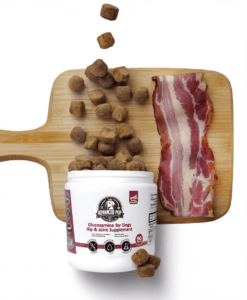
- Choose a supplement with all 7 key ingredients — glucosamine, chondroitin, MSM, turmeric, hemp seed meal, hemp oil, hyaluronic acid
- Make sure serving size is appropriate for your Saint Bernard’s weight — 61+ lbs is 5 chews daily
- Commit to at least 6–8 weeks of consistent daily use before evaluating results
- Keep a daily mobility journal — rising speed, morning stiffness duration, walk willingness
- Maintain healthy weight — every extra pound adds measurable stress to already-compromised joints
- Use orthopedic bedding — reduces joint pressure during the extended rest periods giant breeds need
- Have both hips AND elbows evaluated by your vet — Saint Bernards carry vulnerability in both
- Never stop the supplement because your dog seems better — that improvement is the supplement working
Give Your Saint Bernard More Good Years
With a lifespan of 8–10 years, every year of joint comfort matters. Start supporting your Saint Bernard’s hips and joints today — before visible discomfort sets in.