


Glucosamine HCl vs. Glucosamine Sulfate for Dogs: What’s the Real Difference?
Two forms, two different profiles — and it matters more the bigger your dog is.
Glucosamine HCl (hydrochloride) is typically the more concentrated form of glucosamine, while glucosamine sulfate has the longer track record in joint-health research. Neither is “fake” or inferior — they’re simply bound to different compounds, which changes how much actual glucosamine ends up in each dose. For a large-breed dog like a Bernese Mountain Dog, whose joints carry significantly more body weight every single day, that concentration difference is worth understanding before you buy.
Pick up almost any dog joint supplement and the label will proudly say “with glucosamine.” What it usually won’t tell you — at least not clearly — is which glucosamine. And that’s not a small detail. Glucosamine isn’t sold as a single pure compound; it’s stabilized by being bound to something else, and the “something else” changes both the concentration and, for one form, adds a bit of sodium along for the ride.
If you’ve never checked which form is in your dog’s current supplement, you’re not alone — most owners haven’t, because most labels don’t make it easy to find.
Why This Question Actually Matters
Glucosamine supports the building blocks your dog’s cartilage needs to maintain healthy joint structure and cushioning. But “glucosamine” on a label is really shorthand for a compound that has to be stabilized in salt form to survive manufacturing and digestion. The two most common stabilizing forms used in dog supplements are:
Why Concentration Matters More for Big Breeds Like Berners
A 12-lb Corgi and a 100-lb Berner are not carrying the same daily load through their hips, elbows, and knees. Since larger dogs put more mechanical stress through their joints with every step, the actual glucosamine content per serving — not just the word “glucosamine” on the label — becomes more important as your dog’s weight goes up. This is exactly why weight-based dosing (not a flat one-size dose) matters for breeds like Bernese Mountain Dogs, Saint Bernards, and Rottweilers.
How to Tell Which One Is In Your Dog’s Supplement Right Now
Go check the bag. Here’s exactly what to look for:
- Check the exact wording on the ingredient panel — “Glucosamine HCl” and “Glucosamine Hydrochloride” mean the same thing; “Glucosamine Sulfate,” “Glucosamine Sulfate Potassium,” and “Glucosamine Sulfate Sodium” are the other form.
- If the label just says “Glucosamine” with no form specified, that’s worth a second look — most transparent formulas name the exact form used.
- Look at where glucosamine sits in the ingredient list — ingredients are listed by quantity, so the earlier it appears, the more of it is actually in the formula.
- Look for an actual milligram amount per serving, not just a “proprietary blend” total — blends can hide a low glucosamine dose behind other ingredients.
- Match the form before comparing doses across products — a 500mg HCl serving and a 500mg sulfate serving are not delivering the same amount of actual glucosamine.

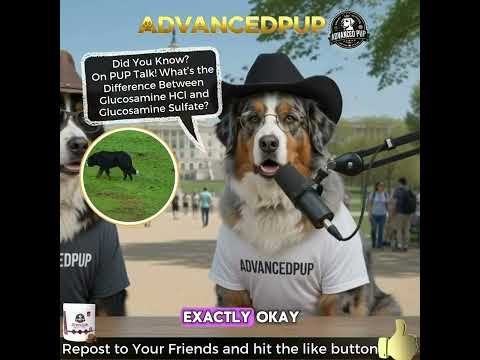
“This is what getting the ingredient math right looks like.” — Full-speed, full-stride, no hesitation. That’s the difference the right form of glucosamine — dosed for a dog this size — can make.
The right form of glucosamine, given consistently, can make a visible difference in how a dog moves. This is 2 dogs describing in practice — a real scenario from consistent daily joint support.
What AdvancedPUP Publishes on Its Label
When you weigh glucosamine HCl vs sulfate for dogs, the harder problem is usually that you cannot tell what is in the bottle you already own. AdvancedPUP’s answer to that is to print every active in milligrams: all seven are itemized on the label, and the 550 mg proprietary blend line is followed by its three components — glucosamine 300 mg, chondroitin 200 mg and MSM 50 mg — which add to exactly 550, so nothing is buried inside the blend. Pet supplement labeling is loosely regulated industry-wide — organizations like the National Animal Supplement Council (NASC) exist specifically to push manufacturers toward clearer labeling and quality standards. AdvancedPUP’s formula is paired with a full support stack rather than relying on glucosamine alone:
Up to 10 lbs: 2 chews daily | 11–30 lbs: 3 chews daily | 31–60 lbs: 4 chews daily | 61+ lbs: 5 chews daily. A 90-lb Bernese Mountain Dog falls in the top bracket — 5 chews daily — while a 12-lb Corgi needs only 3.
Glucosamine HCl vs Sulfate for Dogs: Does the Form Actually Matter?
Here’s the honest, balanced answer: no controlled head-to-head studies in dogs have proven one form definitively outperforms the other for everyday mobility. What we do know is that concentration and dose consistency matter — a supplement with a clearly stated, adequately dosed form of glucosamine, given consistently every day, is more likely to support joint health than a vaguely labeled “proprietary blend,” regardless of which form it uses. The form matters most as a transparency signal: a brand willing to name the exact form and the milligram amount is usually a brand willing to show its full ingredient math.
🦴 AdvancedPUP’s 7-in-1 Formula — Every Milligram Disclosed
Glucosamine + Chondroitin + MSM + Turmeric + Hemp Seed Meal + Hemp Oil + Hyaluronic Acid. All dog sizes, weight-based dosing. Free shipping. 60-Day Empty Bottle Guarantee.
🛒 Shop AdvancedPUP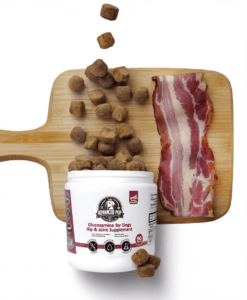
Exactly what I was looking for. Hip and Joint relief supplements in the form of a treat. My dog Hank loves these bacon flavor soft chews. Thank you for sending these so quickly.
HCl vs Sulfate at a Glance — And What the Label Actually Gives Your Dog
Both forms deliver the same active molecule: glucosamine. The difference is how much of the printed milligram figure is glucosamine and how much is the salt it is packaged as.
| Glucosamine HCl | Glucosamine Sulfate | |
|---|---|---|
| Glucosamine by weight | About 83% — 179 of every 215 units of the compound is glucosamine itself | About 59–63% once it has been stabilized |
| What 300 mg on the label delivers | Roughly 249 mg of glucosamine | Roughly 178–188 mg of glucosamine |
| Needs a stabilizer? | No | Yes — it is unstable on its own and is stabilized with potassium chloride or sodium chloride |
| Added potassium or sodium | None from the glucosamine itself | Present, from the stabilizing salt, and included in the printed weight |
| Where you usually see it | Dog chews, powders and soft treats | Human tablets and capsules |
| Research base | The form used in most canine products and canine trials | The larger human osteoarthritis trial record |
That last row matters for fairness: sulfate has the deeper human research record, and some researchers argue the sulfate ion itself contributes to cartilage maintenance. No head-to-head trial in dogs has shown one form to outperform the other. What is not in dispute is the arithmetic — two products can print the same number and not hand your dog the same amount of glucosamine.
What one AdvancedPUP serving actually contains
A serving is 2 chews, and the label lists amounts per serving. Here it is both ways, so you can line it up against whatever basis your current product prints:
| Ingredient | Per chew | Per serving (2 chews) |
|---|---|---|
| Glucosamine | 150 mg | 300 mg |
| Chondroitin | 100 mg | 200 mg |
| MSM | 25 mg | 50 mg |
| Turmeric | 35 mg | 70 mg |
| Hemp Seed Meal | 25 mg | 50 mg |
| Cold Pressed Virgin Hemp Oil | 25 mg | 50 mg |
| Hyaluronic Acid | 1 mg | 2 mg |
The first three appear on the label as a single 550 mg proprietary blend — exactly what 300, 200 and 50 add up to. One 90-count bottle is 45 servings.
Work that arithmetic on any 300 mg figure: as HCl it comes to roughly 249 mg of glucosamine itself; as stabilized glucosamine sulfate, roughly 178–188 mg, with the rest being the sulfate salt and the potassium or sodium chloride holding it together. That is the practical reason to check the form before comparing two labels by their headline numbers — and to check the basis, because a number printed per serving is not the same as one printed per chew.
How many milligrams of glucosamine does a dog actually need per day?
There is no single agreed figure. Published guidance for dogs varies widely by source, by the size of the dog, and by whether the aim is an initial stretch or ongoing maintenance, and well-regarded products land across a broad range. Rather than working backward from a number found online, give your veterinarian your dog’s weight and what you are currently giving, and let them set the amount. When you are comparing two products yourself, the two details that matter most are the easiest to miss: compare the same basis (per chew versus per serving) and the same form. Those change the comparison more than the headline number does.
Does glucosamine sulfate contain sodium or potassium?
The stabilized sulfate forms do. Glucosamine sulfate is unstable on its own, so manufacturers stabilize it with either potassium chloride or sodium chloride, and that salt is counted in the weight printed on the label. Glucosamine HCl needs no stabilizer, which is one reason it is the more common form in dog chews.
Frequently Asked Questions
Related Guides
Know Exactly What’s in Your Dog’s Joint Supplement
AdvancedPUP’s 7-in-1 formula prints all seven actives in milligrams — clearly labeled, weight-based dosing, no guessing required.
🛒 Shop AdvancedPUP — Risk-Free Trial 🛡 60-Day Guarantee | 🚚 Free Shipping | 🇺🇸 Made in USA | 🐶 All Dog Sizes