
Dog Suddenly Won’t Go Up Stairs? 6 Causes & What To Do
When your dog suddenly stops on the staircase — that hesitation is your dog telling you something important. Here’s how to read the signal.
When a dog suddenly won’t go up stairs — or stops using them anymore — the most common cause in dogs over age 5 is joint discomfort — specifically in the hips, knees, or spine. Stairs require significant hip extension and rear leg drive, which makes them one of the first activities dogs quietly avoid when joints start struggling. The key is identifying whether this is a physical issue, a fear response, or a neurological signal — because each requires a different response. Read on for the full breakdown by cause, age, and breed.
You noticed it yesterday — or maybe it’s been building for weeks. Your dog stands at the bottom of the stairs, looks up, and just… doesn’t go. Or they start up and stop halfway. Or they take them much slower than they used to. You might have searched “is my dog scared of stairs” or “why did my dog stop going upstairs” — but what you’re really asking is: is my dog okay?
The answer depends on a few things. But for most dog owners asking this question about a dog over 4 or 5 years old, the answer is the same: this is a physical signal, not a behavioral one — and it usually responds well to the right support.
Why Stairs Are the First Thing Dogs Quietly Give Up
Stairs aren’t just a balance challenge — they’re a significant mechanical load on a dog’s rear joints. Here’s why they’re often the first thing to go:
6 Reasons Your Dog Won’t Go Up Stairs Anymore
Not all stair avoidance has the same cause. Here are the six most common, in order of likelihood by age:
If your dog is one of the long-backed, short-legged breeds in cause #2, stair avoidance deserves extra attention — it’s one of the seven early warning signs covered in our full guide to Dachshund back and joint problems, and the same signals apply to Corgis, Frenchies, and the Shih Tzu — a breed whose build-related risk sits in the spine and the knee rather than the hip.
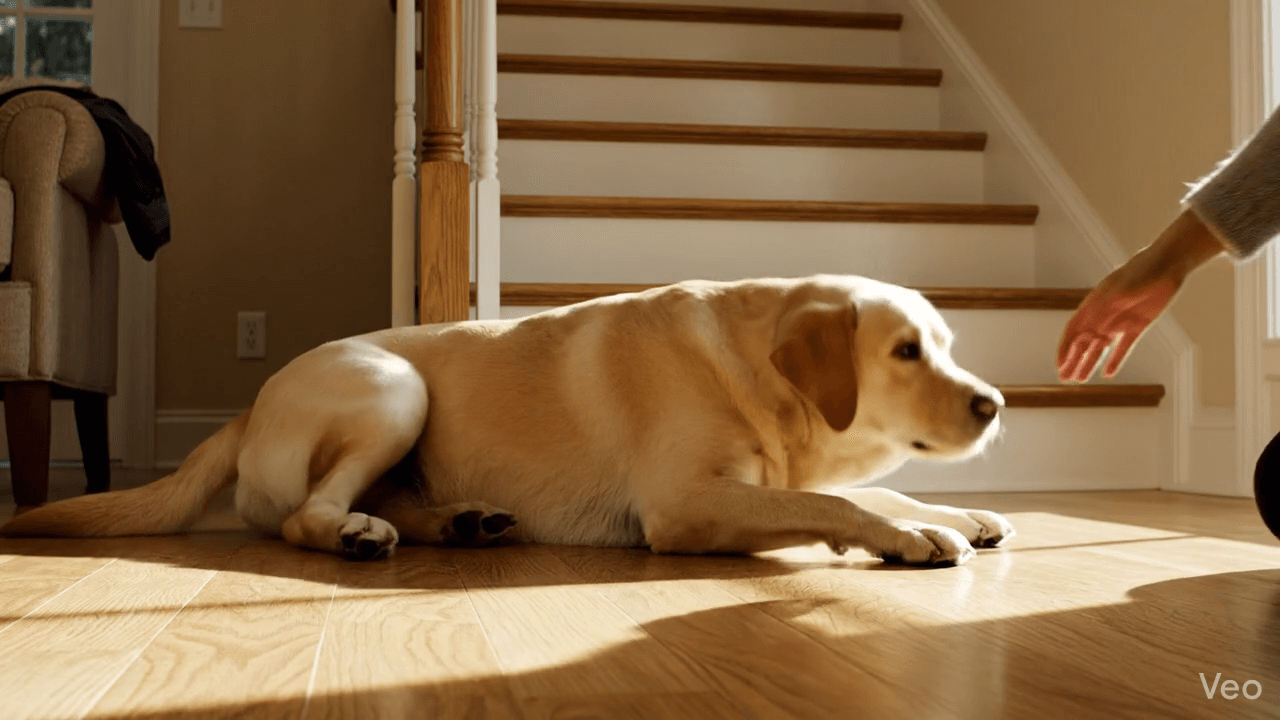
“The pause at the bottom of the stairs.” — Every dog owner who’s seen it knows exactly what this moment feels like. It’s the moment something shifts from normal aging to a signal worth listening to.
How to Tell What’s Causing Your Dog’s Stair Avoidance
Watch your dog carefully over the next 24 hours and look for these specific signals — they’ll tell you which of the six causes above is most likely:
Signs pointing to joint discomfort (most common)
- Slower getting up from lying down — especially in the morning or after a long rest
- Stiffness that wears off after 10–15 minutes of movement — joints warm up, mobility improves
- Reluctance to jump on furniture they previously loved — another high-joint-load activity being quietly avoided
- Going downstairs is harder than going up — descending loads joints differently and often becomes harder first
- Visible hip swaying or “bunny hopping” on the way up — compensating for hip joint instability
Signs pointing to neurological concern — see your vet
- Rear legs crossing or knuckling — toes dragging or turning under while walking
- Loss of coordination — wobbling or falling on the stairs, not just hesitation
- Sudden onset with no gradual buildup — went from normal to stair avoidance in less than a week
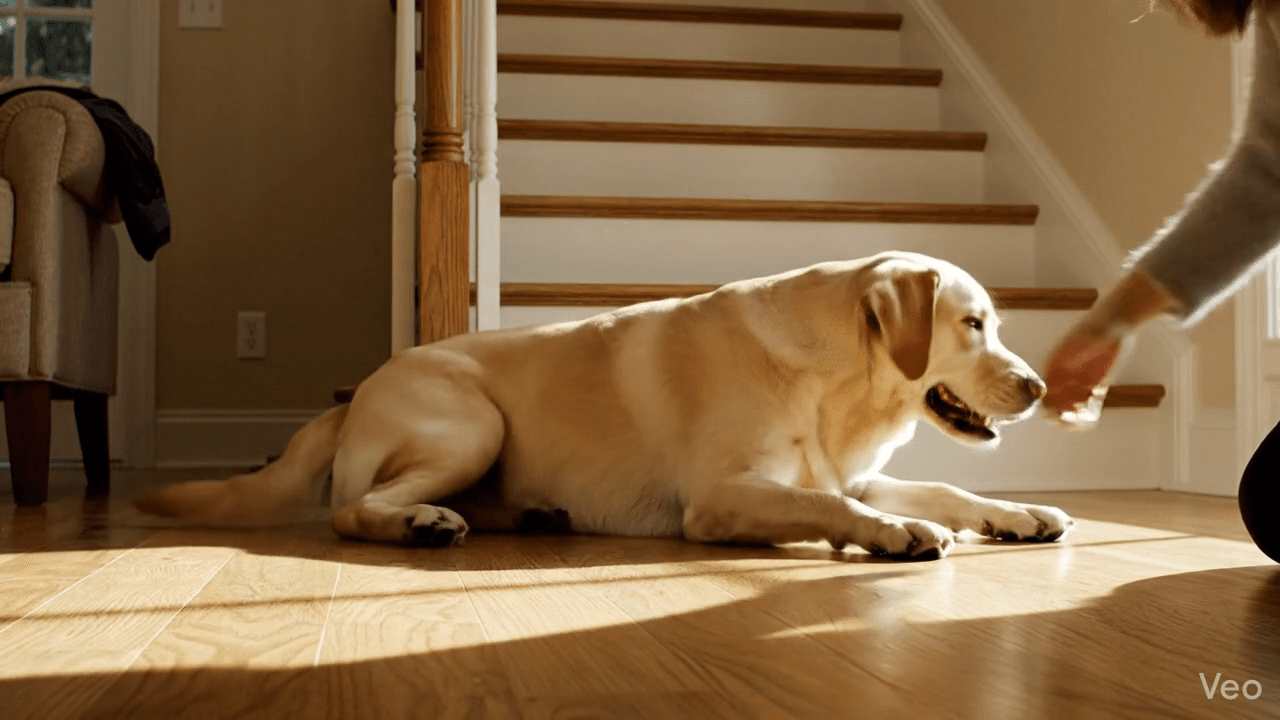
This is what stair hesitation from joint changes actually looks like — and what happens after proper support begins. The difference between before and after in this video is exactly what consistent daily joint support can do.

What to Do Based on Your Dog’s Age
The right response to stair avoidance depends heavily on how old your dog is — because the cause and urgency are very different at different life stages:
Stair avoidance in young dogs is less likely to be joint-related and more likely to be either a fear response (especially if stairs are new or a slip occurred) or an injury. Young dogs with hip dysplasia can show this early — particularly large breeds like German Shepherds, Rottweilers, and Labs. A vet check is worthwhile to rule out developmental hip issues.
Dogs in this range who avoid stairs are showing early joint signal before it becomes a visible problem. Their build allows them to compensate — they’re not limping, they’re not crying — they’re just quietly stopping at the bottom of the stairs. This is the window where joint supplementation has the most impact on long-term mobility outcomes. Don’t wait for it to get worse.
Senior dogs with stair avoidance almost always have a combination of joint changes, muscle loss, and reduced flexibility. The good news is that consistent daily supplementation alongside ramps, orthopedic bedding, and low-impact exercise maintains surprisingly good mobility in most seniors. It’s not too late — senior dogs consistently respond well to support when it’s given consistently.
🦴 AdvancedPUP’s 7-in-1 Formula — Built for Dogs That Are Slowing Down
Glucosamine + Chondroitin + MSM + Hyaluronic Acid + Turmeric + Hemp Oil + Hemp Seed. All dog sizes. Free shipping. 60-Day Empty Bottle Guarantee.
🛒 Shop AdvancedPUP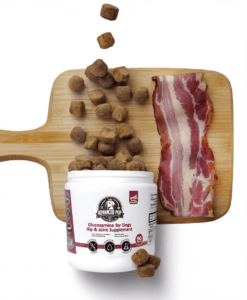
What Actually Helps a Dog Who Won’t Go Up Stairs
If your dog’s stair avoidance is joint-related — the most common cause — here’s a practical action plan organized by what has the most impact:
✅ Immediate changes (do these today)
- Install a ramp or pet stairs with gentle incline — eliminates the steep angle that loads joints most. A 20–25% incline is the sweet spot for joint-friendly access to furniture and cars
- Add carpet runners or yoga mats to bare stairs — slippery surfaces dramatically increase joint loading as dogs scramble for traction
- Move your dog’s sleeping area to the ground floor — if stairs lead to the bedroom, bring their bed downstairs temporarily while you address the root cause
- Switch to a harness with a handle — gives you gentle assist capability on stairs without pulling the neck or collar
✅ Joint support (the most impactful long-term action)
- Start a daily joint supplement with glucosamine, chondroitin, and MSM — the three most evidence-backed ingredients for cartilage support and joint lubrication
- Look for hyaluronic acid in the formula — specifically lubricates joint capsules, reducing the friction that makes stairs uncomfortable
- Give it consistently for 4–6 weeks — glucosamine needs to reach therapeutic levels in joint tissue before visible improvement occurs
- Use weight-based dosing — under 30 lbs needs a different amount than a 70-lb dog. Never assume one chew fits all sizes
❌ What not to do
- Don’t force your dog up the stairs — pushing or luring them past their hesitation doesn’t address the cause and can worsen joint stress
- Don’t wait to see if it gets better on its own — joint changes are progressive, and the window where support has the most impact is now, not after visible decline
- Don’t confuse breed-level risk with your individual dog’s current status — high-risk breeds (GSD, Lab, Rottweiler, Frenchie) may show signs earlier, but any breed can develop joint changes
What’s Actually in an Effective Joint Supplement
Not all joint supplements are built the same. Here’s what the research says about the ingredients that actually move the needle for dogs struggling with stairs:
Up to 10 lbs: 2 chews daily | 11–30 lbs: 3 chews daily | 31–60 lbs: 4 chews daily | 61+ lbs: 5 chews daily. Weight-based dosing ensures every dog — from a 12-lb Corgi to a 130-lb Saint Bernard — gets the right therapeutic amount.
Sadie limps less with this supplement and she treats it like its a treat which is helpful.
Up or Down? What the Direction of the Struggle Tells You
Most owners describe it the same way — “he won’t do the stairs anymore.” But which direction your dog refuses is one of the most useful pieces of information you can hand a veterinarian, because going up and going down load completely different joints.
My dog goes up the stairs fine but won’t come down. What does that mean?
Descending loads the front limbs and asks for balance rather than power, so a dog that climbs comfortably but refuses to come down is more likely dealing with elbow or shoulder discomfort, fading eyesight, or a loss of confidence on slippery treads than with hip trouble. Slick hardwood or tile at the bottom of a staircase is a common and easily fixed cause — a runner or a set of stair treads often changes the behavior within a day or two.
Is it worse if my dog struggles going up rather than down?
Neither direction is automatically more serious — they simply point at different areas. Struggling upward points toward the hips, knees and lower back. Struggling downward points toward the elbows, shoulders, vision or balance. What matters more than direction is how quickly it appeared: a change that shows up over a single day deserves a prompt veterinary exam, while a change that crept in over months is more typical of arthritis.
Frequently Asked Questions
Related Guides
Your Dog Doesn’t Have to Stop at the Bottom of the Stairs
AdvancedPUP’s 7-in-1 formula supports cartilage integrity, joint lubrication, and a healthy inflammatory response — in one daily bacon chew sized for your dog’s weight.
🛒 Shop AdvancedPUP — Risk-Free Trial 🛡 60-Day Guarantee | 🚚 Free Shipping | 🇺🇸 Made in USA | 🐶 All Dog Sizes