

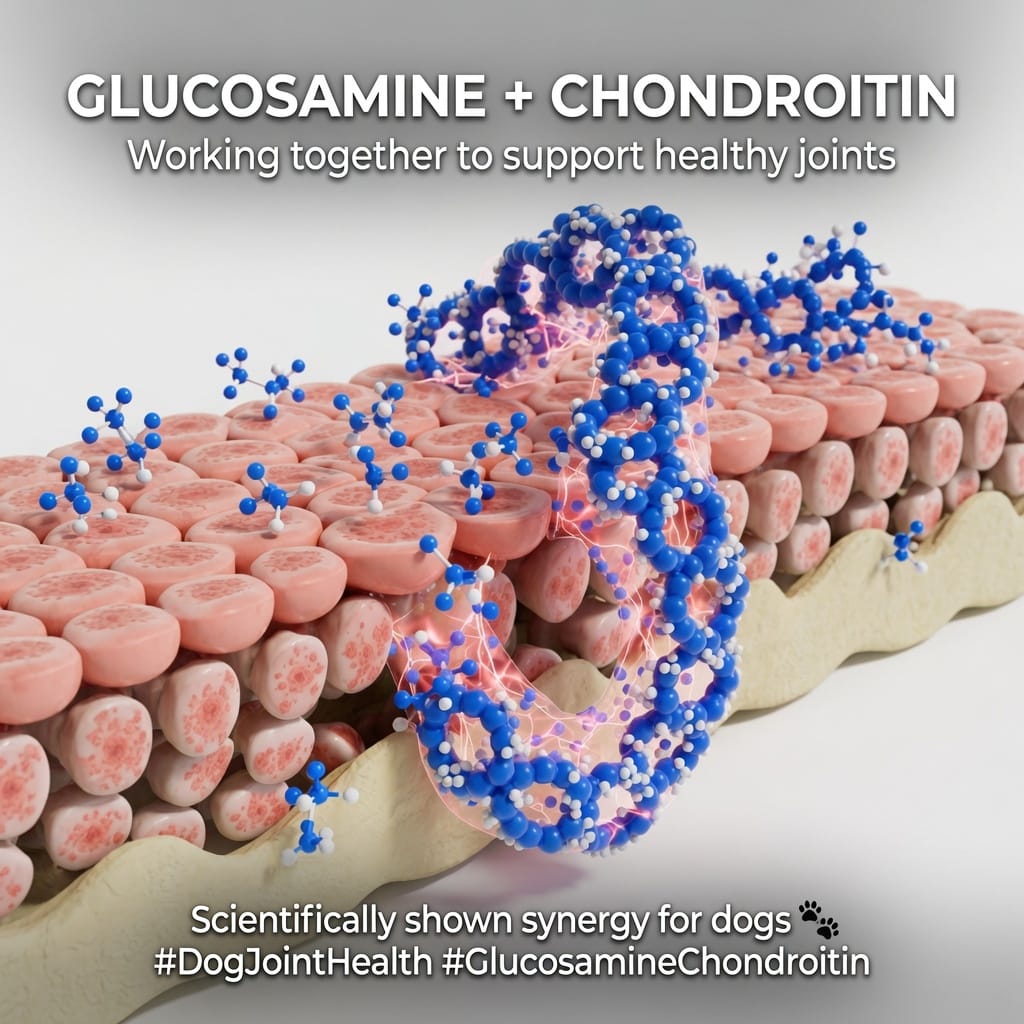
Healthy Dog Joints with Glucosamine and Chondroitin: How the Pair Works Together
One supplies the building blocks of cartilage. The other helps joints hold onto cushioning moisture. Here’s why glucosamine and chondroitin for dogs work better as a team — for every size of pup, from Frenchies to Saint Bernards.
Glucosamine and chondroitin work as a pair: glucosamine supplies raw material your dog’s body uses in cartilage, while chondroitin helps cartilage attract and retain water — the cushioning that keeps movement comfortable. The interesting part is why the combination matters more than either one alone, and which dogs benefit most. Details below.
Ingredient roles referenced here are consistent with quality standards from the National Animal Supplement Council (NASC) and published peer-reviewed veterinary joint-health research.
If you’ve ever flipped over a bag of dog joint chews, you’ve seen these two names side by side. They’re the most studied joint-support pairing in the pet world — but most labels never explain what each one actually does, or why nearly every serious formula includes both. Whether you have a young German Shepherd, a couch-loving Corgi, or a senior Lab starting to slow down, understanding this pair helps you choose (and judge) any joint supplement with confidence.
What Glucosamine Does for Your Dog’s Joints
Glucosamine is a naturally occurring compound your dog’s body already produces — it’s a core building block of cartilage, the smooth tissue that caps the ends of bones so joints glide instead of grind. As dogs age, natural glucosamine production slows while daily wear continues. Supplementing helps make sure the raw material is there when the body goes to maintain cartilage.
AdvancedPUP uses glucosamine HCl, a highly concentrated form. If you’re curious how HCl compares to the sulfate form found in some other brands, we break that down fully in our guide to glucosamine HCl vs. sulfate for dogs.
What Chondroitin Does (The Underrated Half)
Chondroitin sulfate gets less attention, but it handles a different, equally important job: it helps cartilage attract and hold water. Hydrated cartilage is springy cartilage — it absorbs impact from every step, jump, and zoomie session. Chondroitin also helps support the normal balance of cartilage maintenance, so the tissue your dog has works the way it should.
Think of it this way: glucosamine helps supply the bricks, while chondroitin helps keep the mortar flexible and cushioned.
🧱 Glucosamine
- Building block for cartilage structure
- Supports the body’s natural cartilage maintenance
- Production naturally declines with age
- HCl form = concentrated delivery
💧 Chondroitin
- Helps cartilage attract and retain water
- Supports shock absorption and cushioning
- Supports normal cartilage balance
- Complements glucosamine’s role
Why Glucosamine and Chondroitin Work Better Together for Dogs
Because the two ingredients handle different halves of the same system — structure and cushioning — the pairing covers more ground than either alone. That’s why the glucosamine-chondroitin combination has become the foundation of nearly every credible dog joint formula, and why veterinary joint-health research so often studies them together rather than separately.
Consistency matters more than any single serving. These ingredients support the body’s own processes, so they build gradually with daily use — most owners notice changes over a period of weeks, not days. For the honest week-by-week breakdown, see our full guide on how long glucosamine takes to work in dogs.
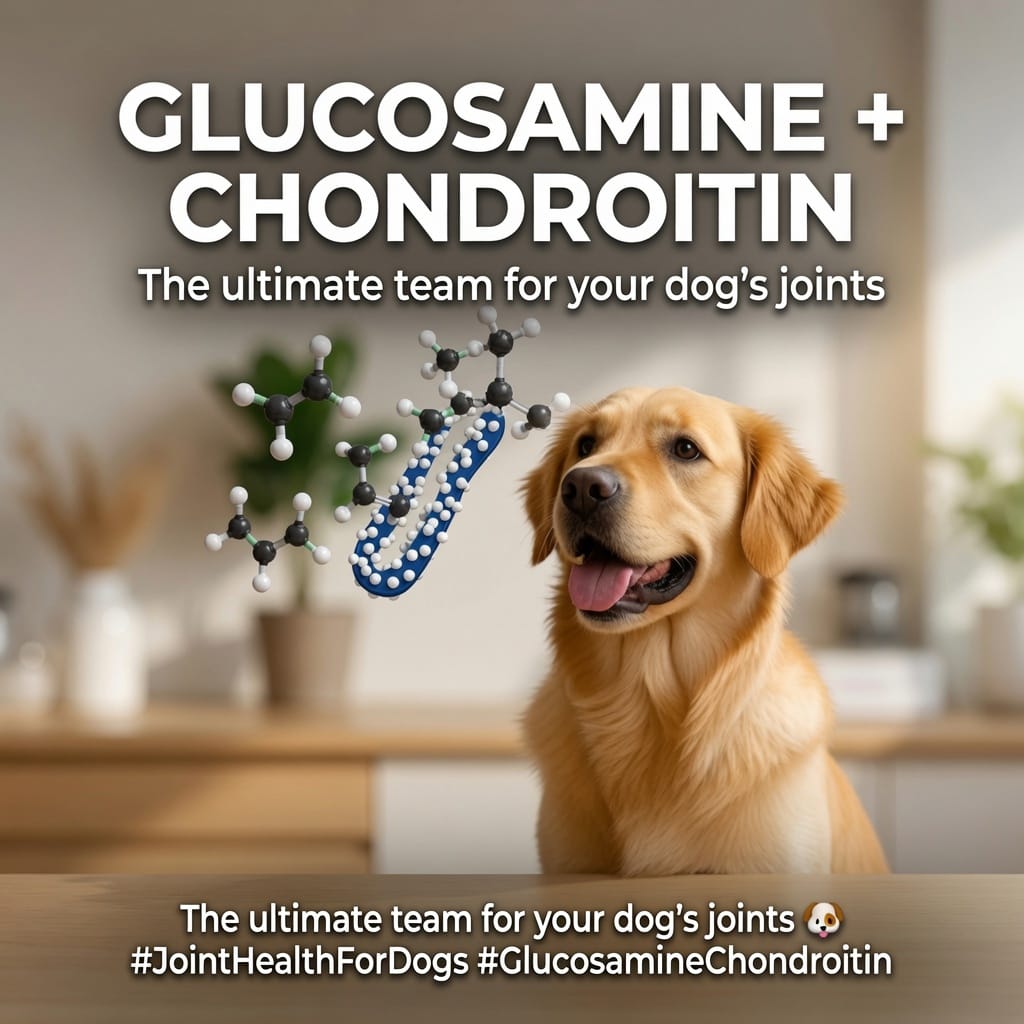
How This Pair Fits Into a 7-in-1 Formula
Glucosamine and chondroitin are the foundation — but a complete formula supports the whole joint system. AdvancedPUP’s Professionally Formulated chews combine the pair with five more research-backed ingredients:
Serving size is weight-based, so small breeds and giant breeds each get the right amount: 2 chews for dogs 10 lbs and under, 3 chews for 11–30 lbs, 4 chews for 31–60 lbs, and 5 chews for dogs 61 lbs and up.
Is Your Dog a Candidate for Glucosamine + Chondroitin?
- Slowing down on walks or lagging behind where they used to lead
- Hesitating at stairs, the couch, or the car door
- Stiffness after naps or first thing in the morning
- A large or giant breed (GSD, Rottweiler, Saint Bernard, Bernese) — or a small breed prone to joint issues (Frenchie, Corgi, Dachshund)
- Age 7+ — or younger for breeds with known joint vulnerability
- Very active dogs whose joints work overtime
Checked two or more? Our decision guide walks you through it: Does my dog need a joint supplement?
Frequently Asked Questions
Can I give my dog human glucosamine and chondroitin?
It’s not recommended — human products may contain xylitol or other additives unsafe for dogs, and dosing isn’t weight-calibrated for pets. Choose a supplement formulated specifically for dogs.
Is it safe to give glucosamine and chondroitin every day?
Yes — daily use is exactly how these ingredients are designed to work, since they support the body’s ongoing maintenance processes. Follow the weight-based serving size on the label.
What’s the difference between glucosamine and chondroitin?
Glucosamine supplies building blocks for cartilage structure, while chondroitin helps cartilage attract and retain water for cushioning. They handle different halves of the same joint system.
How long until I notice a difference?
Most owners notice changes gradually over several weeks of consistent daily use. See our week-by-week glucosamine timeline for the full breakdown.
Do small dogs need glucosamine and chondroitin too?
Absolutely — breeds like French Bulldogs, Corgis, and Dachshunds have well-known joint vulnerabilities. Weight-based serving sizes make the same formula work for a 9 lb pup or a 120 lb gentle giant.
Keep Reading
Glucosamine + Chondroitin + 5 More — In One Bacon Chew
The complete 7-in-1 formula with the pair your dog’s joints rely on, plus hyaluronic acid for lubrication. Free shipping on every order, backed by our 60-Day Empty Bottle Guarantee.
Shop AdvancedPUP Hip & Joint →