

Choosing a Shih Tzu joint supplement usually comes down to two questions nobody answers properly: what you should actually be watching for in a 9-to-16-pound dog, and how much of it your dog should be getting. Here is both.
Shih Tzu Joint Supplement: The Right Dose, and What Actually Matters
Most Shih Tzu joint advice is written for big dogs and shrunk down. That gets two things wrong — the problem you should actually be watching for, and the amount your dog should be getting.
Quick Answer: What Should a Shih Tzu Joint Supplement Actually Do?
Most owners go looking for a Shih Tzu joint supplement because they have heard small dogs get hip trouble. Right instinct, wrong target. A Shih Tzu is not a hip dysplasia breed the way a German Shepherd is, and two other things drive their stiffness. First, they are a short-legged (chondrodystrophic) breed — the same category as the Dachshund and the Corgi — and that build changes how the cushioning discs in the spine age. Second, they live a long time: UK primary-care records for 11,082 Shih Tzus put median lifespan at 12.7 years, which is a lot of years for a body to carry itself around.
Then there is the practical catch almost every article skips. The breed standard is 9 to 16 pounds — which straddles the dosing line on most joint supplements, including ours. A 9-pound Shih Tzu and a 15-pound Shih Tzu do not take the same amount.
Sources: AKC Official Breed Standard · O’Neill et al., RVC VetCompass, 2024

Fine one day, stiff the next — why it looks sudden when it isn’t.
What Shih Tzu Owners Get Told, and What the Records Show
Three claims come up on nearly every page about choosing a Shih Tzu joint supplement. Here is how each one holds up against the actual veterinary data.
| What you’ll read | What the evidence shows |
|---|---|
| “Shih Tzus are prone to hip dysplasia.” | Not as a leading problem. In UK primary-care records covering 11,082 Shih Tzus, the most commonly recorded conditions were periodontal disease (9.5%), anal sac impaction (7.4%) and ear disorders (5.5%). Joint disease did not appear in the top tier at all. |
| “Luxating patella is the Shih Tzu problem.” | It’s a small-breed risk they share, but they are not the worst affected. In a study of 210,824 dogs in England, overall prevalence was 1.30%, and the highest-prevalence breeds were the Pomeranian (6.5%), Yorkshire Terrier (5.4%) and Chihuahua (4.9%). The Shih Tzu was not among the breeds with raised odds. |
| “Small dogs don’t need joint support.” | Size isn’t the risk factor — build is. The Shih Tzu is classed as both brachycephalic and chondrodysplastic, and carries the CDDY chondrodystrophy variant that is associated with early disc degeneration. |
Sources: Demography, common disorders and mortality of Shih Tzu dogs under primary veterinary care in the UK · The epidemiology of patellar luxation in dogs attending primary-care veterinary practices in England
Why a Shih Tzu’s Build Matters More Than Their Size
Look at a Shih Tzu from the side and you’ll see a body that is longer than it is tall, on short legs. That shape is not just cosmetic. It comes from an extra copy of a growth gene — the FGF4 retrogene — which shortens the leg bones and, in the version called CDDY, also causes the soft centre of the spinal discs to harden much earlier in life than it should.
The University of California, Davis Veterinary Genetics Laboratory lists the Shih Tzu among the breeds that carry CDDY, at a reported allele frequency of roughly 0.16 in the dogs tested. Two things follow from that, and both matter:
Not every Shih Tzu carries it
An allele frequency of 0.16 means the variant is present in the breed, not that every dog has it. Carrying it is also not a diagnosis — plenty of carriers never develop a disc problem.
The change starts early
Where CDDY is present, disc hardening begins in the first year of life — long before any owner sees a symptom. That’s why joint and back support in this breed is a before decision, not an after one.
If this sounds familiar, it should: it’s the same genetics story behind the Dachshund’s back problems and the Corgi’s. The Shih Tzu is a milder version of the same build.
Source: UC Davis Veterinary Genetics Laboratory — Chondrodystrophy (CDDY/IVDD) and Chondrodysplasia (CDPA)
6 Early Signs of Joint Trouble in a Shih Tzu
A Shih Tzu rarely limps first. Because they are small and easily carried, they can compensate for a long time — the early signals are changes in what they choose to do, not how they walk.
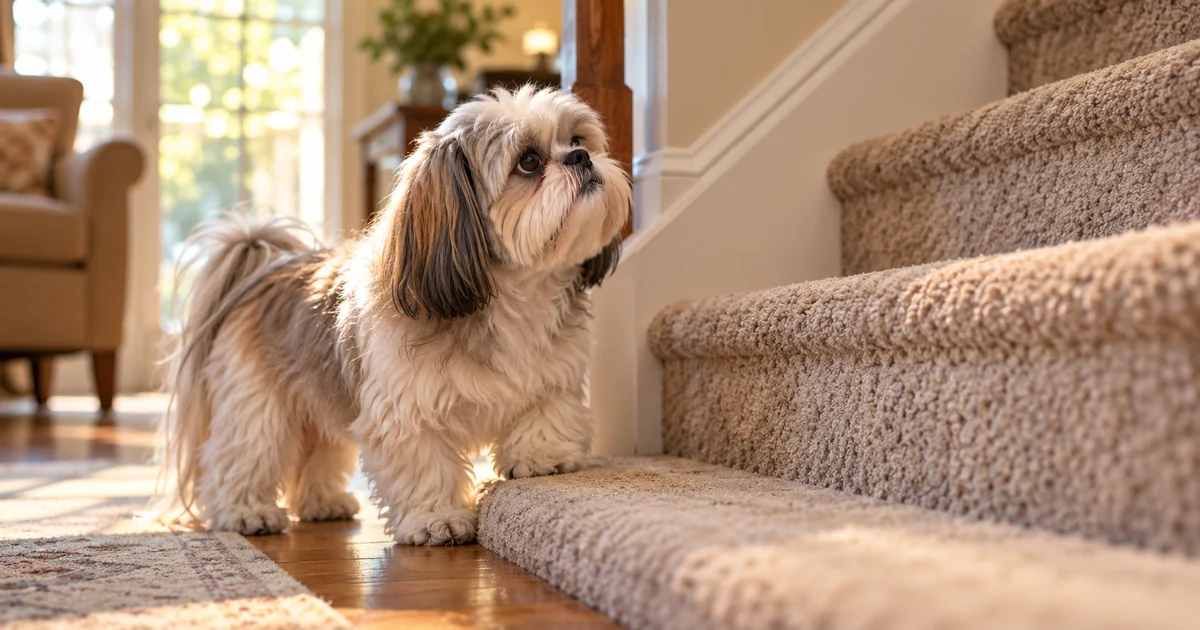
A pause at the bottom of the stairs
Not refusing — just a beat of hesitation before starting up, or waiting to be carried. Stair hesitation is one of the most reliable early signals in any breed.
A skip or “bunny hop” on a back leg
A few steps on three legs, then normal again. That brief skip is the classic sign of a kneecap slipping out and back — worth having a vet grade it.
Not wanting to be picked up
Turning away, ducking, or tensing when lifted under the chest. In a long-backed dog this can mean the lift itself is uncomfortable.
The walk gets shorter
They still want to go — they just want to turn back sooner, or sit down partway. Slowing down on walks is rarely just age.
Splaying on smooth floors
Laminate and tile are hard work for a short-legged dog, and long foot hair makes it worse. Scrabbling or sliding is a load problem, not clumsiness.
Stiff for the first few minutes
Awkward getting out of bed, fine ten minutes later. Morning stiffness that eases with movement is one of the earliest signs of joint wear.
Recognise two or more of those?
None of them mean it’s too late — they mean it’s early. See exactly what a Shih Tzu-sized serving contains, printed in milligrams.
🚨 When It’s a Vet Visit, Not a Supplement
Some signs need a diagnosis, not a chew. Call your vet — the same day — if you see any of these:
- Sudden weakness, wobbliness or dragging in the back legs. In a chondrodystrophic breed this can indicate a disc problem, and timing matters.
- Crying out when picked up or touched along the back.
- A leg held up repeatedly, or a kneecap you can see or feel moving out of place.
- Any loss of bladder or bowel control alongside back-end weakness.
A joint supplement is daily support for normal wear. It is not a treatment for a diagnosed orthopaedic condition, and it should never delay a visit when something changes suddenly.
What Actually Helps a Shih Tzu’s Joints
1. Body condition — lean, not skinny
Every extra ounce is carried by the same small frame, and weight is the one variable you fully control. But don’t overcorrect: the England patellar luxation study found that dogs below their breed’s average weight had 1.4 times the odds of a luxation diagnosis compared with dogs at or above it. Aim for a waist you can see and ribs you can feel under the coat — not a thin dog.
2. Traction at home
Runners and rugs on the routes they use most — bed to door, sofa to food bowl. Keep the hair between the paw pads trimmed. This is the cheapest change on this list and often the most noticeable.
3. Ramps, steps, and how you lift
A set of steps at the sofa and the bed removes the two biggest daily impacts. And when you do lift, support the chest and the rear at the same time — never scoop under the front legs and let the back end hang.
4. Daily joint support, started before the limp
A Shih Tzu joint supplement is a slow instrument. Glucosamine, chondroitin and the supporting ingredients work cumulatively — they are not a rescue. In a breed where disc changes begin in the first year and the median lifespan is nearly 13 years, starting in middle age rather than old age is the whole point. Most owners see nothing for the first few weeks; here’s how long glucosamine actually takes to work.

The Serving Question: 9 to 16 Pounds Straddles the Line
This is the part the roundups skip, and it is the most practical thing to get right about any Shih Tzu joint supplement. The AKC standard puts a mature Shih Tzu at 9 to 16 pounds — which means the breed sits on both sides of the first dosing band on most joint supplements, including AdvancedPUP.
So weigh your dog. Don’t estimate, and don’t assume “small dog, smallest dose”:
| Your Shih Tzu’s weight | Daily serving | One bottle lasts | Per day |
|---|---|---|---|
| Up to 10 lbs | 2 chews | 45 days | about $0.78 |
| 11 to 30 lbs | 3 chews | 30 days | about $1.17 |
Based on 90 chews per bottle at $34.98.
What’s in each serving
All seven actives are printed on the label with their amounts — which is the thing worth checking on any brand you compare, because a blend total on its own doesn’t tell you how much of anything you’re getting.
| Ingredient | 2 chews (up to 10 lbs) | 3 chews (11–30 lbs) |
|---|---|---|
| Glucosamine | 300 mg | 450 mg |
| Chondroitin | 200 mg | 300 mg |
| MSM | 50 mg | 75 mg |
| Turmeric | 70 mg | 105 mg |
| Hemp Seed Meal | 50 mg | 75 mg |
| Hemp Cold Pressed Virgin Hemp Oil | 50 mg | 75 mg |
| Hyaluronic Acid | 2 mg | 3 mg |
Our label does carry a 550 mg proprietary blend line — and it prints the three components underneath it: glucosamine 300 mg, chondroitin 200 mg and MSM 50 mg, which add to exactly 550.

Daily Joint Support Sized for a Shih Tzu
As a Shih Tzu joint supplement, AdvancedPUP 7-in-1 Hip & Joint chews are bacon-flavoured soft chews made in an NSF-Certified GMP facility, with every active printed on the label in milligrams. One formula suits every size of dog — the serving changes, not the chew.
- 2 chews up to 10 lbs · 3 chews from 11 lbs
- 90 chews a bottle — 30 to 45 days
- About $0.78 a day at the 2-chew serving
✓ 60-Day Empty Bottle Guarantee — finish the bottle, and if you’re not satisfied, we’ll make it right.
Shih Tzu Joint & Mobility FAQ
How many chews does a Shih Tzu need per day?
It depends where your dog falls in the 9-to-16-pound range. Up to 10 pounds is 2 chews a day; 11 to 30 pounds is 3. Because the breed sits right on that boundary, weigh your dog rather than estimating — a 9-pound and a 15-pound Shih Tzu genuinely need different amounts.
Do Shih Tzus get hip dysplasia?
It happens, but it is not one of their defining problems. In UK primary-care records for 11,082 Shih Tzus, the most commonly recorded conditions were dental, anal sac and ear problems — joint disease was not in the top tier. Their build-related risk sits more in the spine than the hip.
Are Shih Tzu joint problems hereditary?
Partly. The CDDY chondrodystrophy variant behind early disc degeneration is inherited and can be identified by a DNA test, and knee conformation tends to run in lines too. That is why responsible breeders screen. It is not the whole story though — body condition, flooring and daily impact all shape how a dog actually ages.
My Shih Tzu is only 3 — is that too young for joint support?
No. Where CDDY is present, disc change begins in the first year of life, long before anything is visible. Joint ingredients are cumulative rather than corrective, so starting while a dog still moves well is the point of them. If your dog is under a year, check with your vet first.
Can a joint supplement help a luxating patella?
No — a luxating patella is an orthopaedic condition that a vet grades and manages, and in some grades it is a surgical decision. A daily joint supplement is general support alongside whatever your vet recommends, not a treatment for the luxation itself. If you can see a kneecap moving out of place, that is a vet appointment.
Are Shih Tzus at risk of disc problems?
Some are. The Shih Tzu is a chondrodystrophic breed and carries the CDDY variant associated with early disc degeneration, at a reported allele frequency of around 0.16. That means the variant is present in the breed rather than in every dog, and carrying it is not a diagnosis. Sudden back-end weakness is always an urgent vet visit.
Will a Shih Tzu actually eat the chews?
They are soft bacon-flavoured chews, not hard tablets, which matters for a flat-faced breed with a small jaw. If your dog is fussy or struggles with the size, break a chew into pieces or crumble it over a meal — the serving is the same either way.
My Shih Tzu is overweight. Do I dose by their current weight?
Yes — serve by what your dog weighs now, not their target. But treat the weight itself as the bigger job: on a frame this small, excess weight is the single largest load on the joints, and a vet-guided plan will do more than any supplement can.
When should I start joint support for a Shih Tzu?
Earlier than most owners do. Where CDDY is present, disc change begins in the first year of life, and with a median lifespan of 12.7 years there is a long stretch of middle age in which support is cumulative rather than reactive. Many owners start somewhere around 4 to 6 years, or at the first sign of hesitation on stairs.
How long before I see a difference?
Joint ingredients build up over weeks, not days. Give it a full bottle before judging, keep the serving consistent, and watch behaviour rather than gait — stairs, jumping up, and how long the walk lasts.