
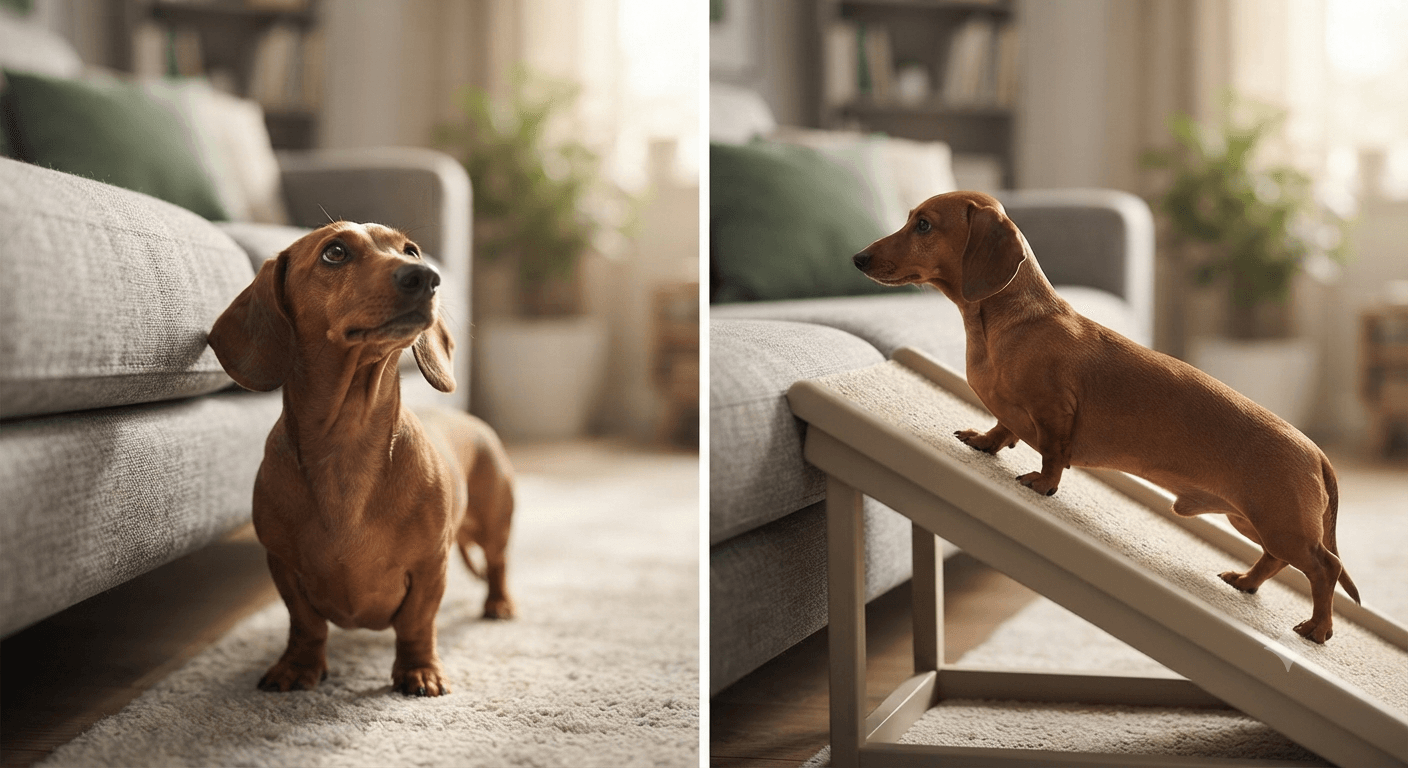
Dachshund back problems rarely start with a dramatic yelp — they start quietly, with a hesitation at the couch or a skipped step on a walk. This guide covers why the breed’s build creates back and joint challenges, the 7 early signs to watch for, and what actually helps.
Dachshund Back & Joint Problems: The Early Signs Most Owners Miss
That hesitation before jumping on the couch isn’t quirky behavior — it’s often the first sign of the back and joint challenges built into the Dachshund’s iconic shape. Here’s what to watch for, and what actually helps.
Quick Answer: Why Do Dachshunds Have Back and Joint Problems?
Dachshunds are a chondrodystrophic (“long body, short leg”) breed — the same category as the Shih Tzu, which carries the same CDDY disc variant. The same gene that gives them their shape also changes how the cushioning discs in their spine age — and it puts extra load on their knees and hips. Peer-reviewed research found roughly 1 in 6 Dachshunds experiences intervertebral disc disease (IVDD) in their lifetime. But the disc issue is only half the story — there’s a second joint problem in Dachshunds that gets far less attention, and it’s the one owners can actually get ahead of. Both are covered below.
📊 Prevalence data: DachsLife 2015 study, Canine Genetics and Epidemiology (peer-reviewed) • Breed health statistics: Orthopedic Foundation for Animals (OFA)

60 seconds: the early warning signs Dachshund owners miss — watch before you read.
Why the Dachshund’s Build Works Against Their Joints
Dachshunds were bred to go down badger tunnels — long, low, and fearless. That shape comes from a gene variant that alters cartilage development throughout the body. It’s the same reason Corgis, Basset Hounds, and French Bulldogs share similar spine and joint challenges.
In Dachshunds, this affects three areas:
The Spine (IVDD)
The discs between vertebrae harden and lose their shock-absorbing ability earlier than in other breeds. The DachsLife 2015 study of over 2,000 Dachshunds found a 15.7% overall IVDD rate — rising to 24.4% in standard smooth-haired Dachshunds.
The Knees (Luxating Patella)
Like most small breeds, Dachshunds are prone to kneecaps that slip out of their groove. The telltale sign is a “skipping” step — your dog lifts a back leg for a few strides, shakes it, then walks normally again.
The Hips & Front Legs
Short, angled legs carry a proportionally long body. Over years, that loading pattern contributes to cartilage wear and the stiffness owners often chalk up to “just getting older.”
Here’s the part most Dachshund content skips: these problems feed each other. A slipping kneecap changes how your dog moves, which changes how weight travels up through the hips and spine. Supporting joint health isn’t about one body part — it’s about the whole chassis.
7 Early Signs of Back & Joint Trouble in Dachshunds
Dachshunds are famously stoic — they rarely cry out until discomfort is significant. Watch for behavior changes instead:
1. Hesitating before jumping
Pausing at the couch or bed they used to leap onto without thinking. Often the very first sign.
2. Avoiding stairs
Stopping at the bottom step, waiting to be carried, or taking stairs one careful leg at a time.
3. Tensing when picked up
Flinching, wincing, or going rigid when lifted — especially with a hand under the belly.
4. The “skipping” step
A back leg lifted for a few strides mid-walk, then back to normal. Classic luxating patella pattern.
5. A hunched or roached back
Standing with an arched spine, head held low, or a tucked belly — signs of back discomfort.
6. Shivering without cold
Trembling paired with reluctance to move can signal spinal discomfort in Dachshunds.
7. Slowing down on walks
Lagging behind, sitting mid-walk, or losing enthusiasm for the leash.
🚨 When It’s an Emergency — Go to the Vet Immediately
IVDD can escalate quickly. These signs are not “wait and see” — they need a veterinarian the same day:
- Dragging one or both back legs, wobbling, or crossing legs when walking
- Sudden inability to stand or jump
- Loss of bladder or bowel control
- Yelping when touched along the back or neck
Early intervention dramatically improves outcomes for disc episodes. No supplement is a substitute for veterinary care in these situations.
What Actually Helps a Dachshund’s Back and Joints
1. Keep them lean — this is the big one
Every extra pound on a Dachshund loads a spine that’s already doing overtime. Research consistently links excess weight to higher back-injury risk. You should be able to feel ribs easily under a thin layer of padding.
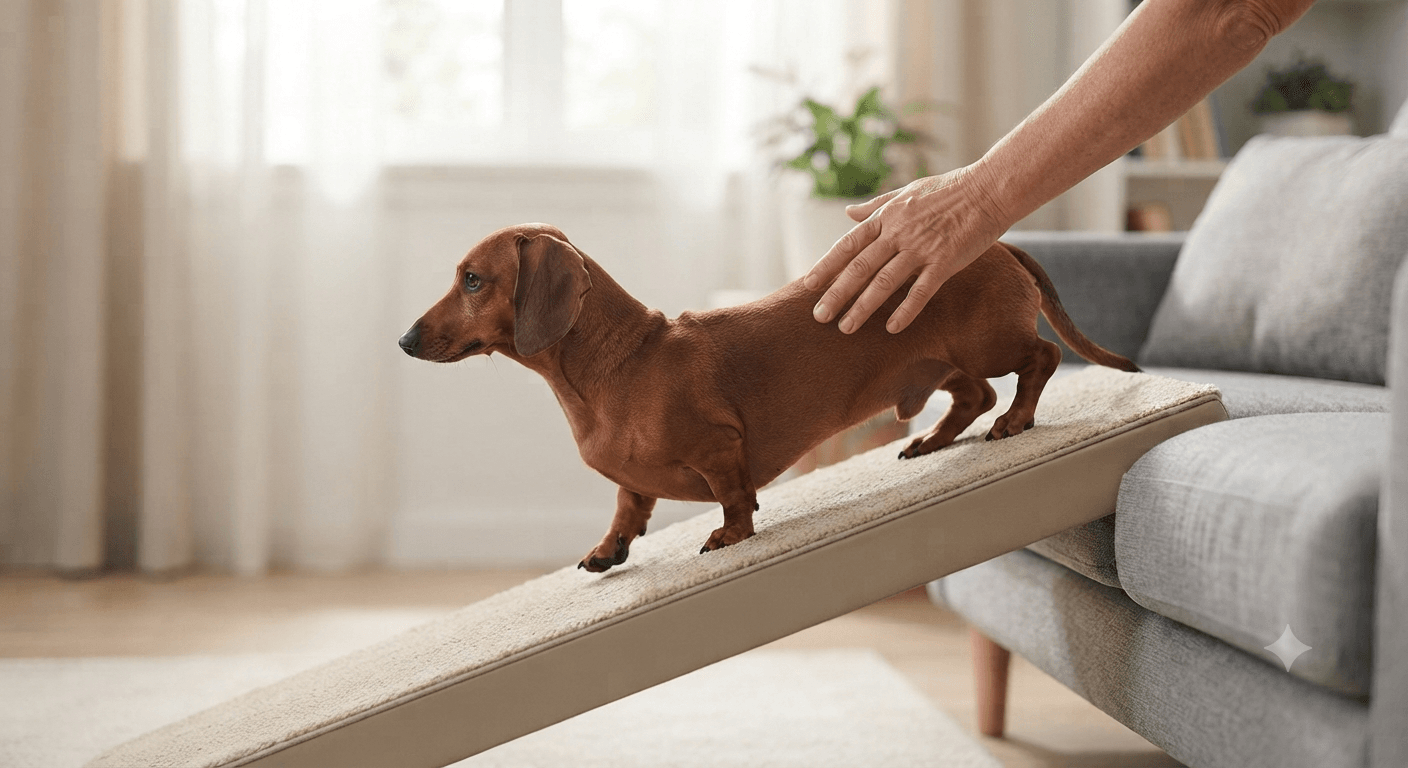
2. Ramps for furniture, and manage the big jumps
A ramp to the couch or bed removes hundreds of hard landings per year. Interestingly, the DachsLife study found that regularly active Dachshunds fared better than sedentary ones — so the goal isn’t bubble-wrapping your dog. It’s replacing high-impact landings while keeping daily walks and muscle tone.
3. Support with the right leash gear
A well-fitted harness spreads force across the chest instead of yanking the neck and spine.
4. Daily joint support — started early
Cartilage wear is cumulative and doesn’t announce itself until it’s advanced. That’s why many Dachshund owners start a joint support routine in early adulthood rather than waiting for symptoms. Look for a formula that covers cartilage building blocks, joint lubrication, and a healthy inflammatory response together:
Glucosamine HCl
A building block of cartilage — the concentrated HCl form, not the sulfate form found in many budget brands.
Chondroitin Sulfate
Works alongside glucosamine to support cartilage structure and resilience.
Turmeric
Supports a healthy inflammatory response — standardized to Turmericoids.
MSM
A sulfur compound that supports joint comfort and connective tissue.
Hyaluronic Acid
A key component of joint fluid — supports lubrication and smooth movement.
Hemp Seed Meal & Cold Pressed Virgin Hemp Oil
Plant-based omega fatty acids that support joint comfort and overall mobility.
All seven of these are in a single AdvancedPUP chew — no stacking multiple bottles.
Serving Size for Dachshunds (Minis Get Great Value)
AdvancedPUP uses weight-based serving sizes, which means small dogs use fewer chews per day — and a bottle lasts longer:
| Dog’s Weight | Chews Per Day | Typical Dachshund |
|---|---|---|
| Up to 10 lbs | 2 chews | Miniature Dachshund |
| 11–30 lbs | 3 chews | Standard Dachshund |
| 31–60 lbs | 4 chews | — |
| 61+ lbs | 5 chews | — |
For a Miniature Dachshund at 2 chews per day, one bottle stretches significantly further than it does for a large breed — making daily joint support genuinely affordable for small-dog owners.
One formula, all dog sizes. The same chews supporting a 9-lb Miniature Dachshund work for a Chihuahua, a Corgi, a Labrador, or a 150-lb Saint Bernard — the serving size scales with the dog, so multi-dog households only need one bottle on the counter.
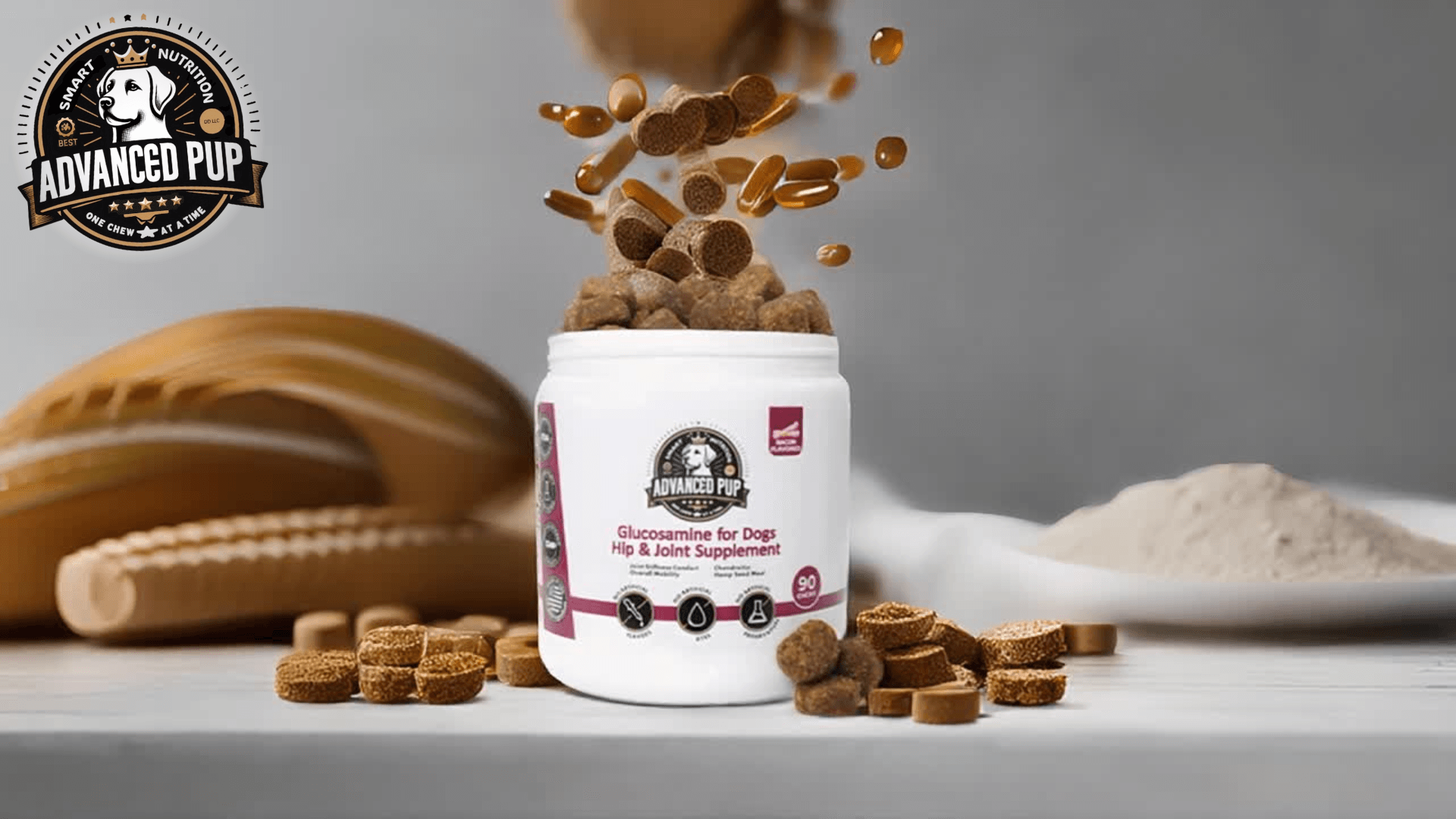
Give Your Dachshund’s Back & Joints Daily Support
7 active ingredients in one bacon-flavored chew. Just 2 chews a day for Minis, 3 for Standards. Free shipping on every order — and 60 days to decide, risk-free.
Shop AdvancedPUP Chews →✅ 60-Day Empty Bottle Guarantee — love it or your money back, even if the bottle’s empty.
Dachshund Back & Joint FAQ
Why do Dachshunds have back problems?
Dachshunds carry a gene that alters cartilage development, causing spinal discs to harden and lose cushioning earlier than in other breeds. Combined with their long back and short legs, this makes them the breed most associated with intervertebral disc disease (IVDD).
What are the first signs of back problems in a Dachshund?
The earliest signs are usually behavioral: hesitating before jumping on furniture, avoiding stairs, tensing when picked up, or a hunched posture. Dachshunds are stoic, so subtle changes matter.
At what age do Dachshunds develop back problems?
IVDD is most commonly diagnosed between ages 4 and 8, though it can appear earlier. Knee and general joint wear tends to build gradually throughout adulthood.
When is a Dachshund back problem an emergency?
Dragging the back legs, sudden inability to stand, or loss of bladder or bowel control require a veterinarian the same day. Fast treatment significantly improves outcomes.
Do Dachshunds get luxating patella too?
Yes — like most small breeds, Dachshunds are prone to kneecaps slipping out of place. The classic sign is a skipping step where a back leg lifts for a few strides and then returns to normal.
Can supplements help a Dachshund with IVDD?
Supplements do not treat or prevent IVDD, which requires veterinary care. Joint support formulas are used alongside vet-guided care to support overall joint comfort, cartilage health, and mobility.
When should I start joint support for my Dachshund?
Many owners start in early adulthood, since cartilage wear builds silently over years. Ask your veterinarian what’s appropriate for your dog’s age and health status.
How many chews does a Dachshund need per day?
Serving size is weight-based: 2 chews daily for dogs up to 10 lbs (most Minis) and 3 chews for 11–30 lbs (most Standards). This makes a bottle last longer for small dogs.
Is AdvancedPUP suitable for small dogs like Miniature Dachshunds?
Yes — AdvancedPUP is formulated for all dog sizes with weight-based serving sizes, from small breeds like Miniature Dachshunds and Chihuahuas to giant breeds like Saint Bernards.